 guide
GUIDE
The Rosslyn–Ballston Corridor: Arlington's Urban Villages
Five station areas offer a useful way into Arlington, but the best comparison happens on the blocks you would actually use.
CAPITAL REGION · COMMUNITY
Clarendon brings together an Arlington Metro station, commercial streets and surrounding homes in a setting that changes from block to block. The county describes a mix of apartments, condominiums, single-family homes, offices, independent businesses and chains. Begin around Clarendon Metro, then include Market Common and the residential streets relevant to your visit. This gives a fuller picture than a single meal or apartment tour. Clarendon also has an important Vietnamese American history: its former Little Saigon was a center of commerce and community life.
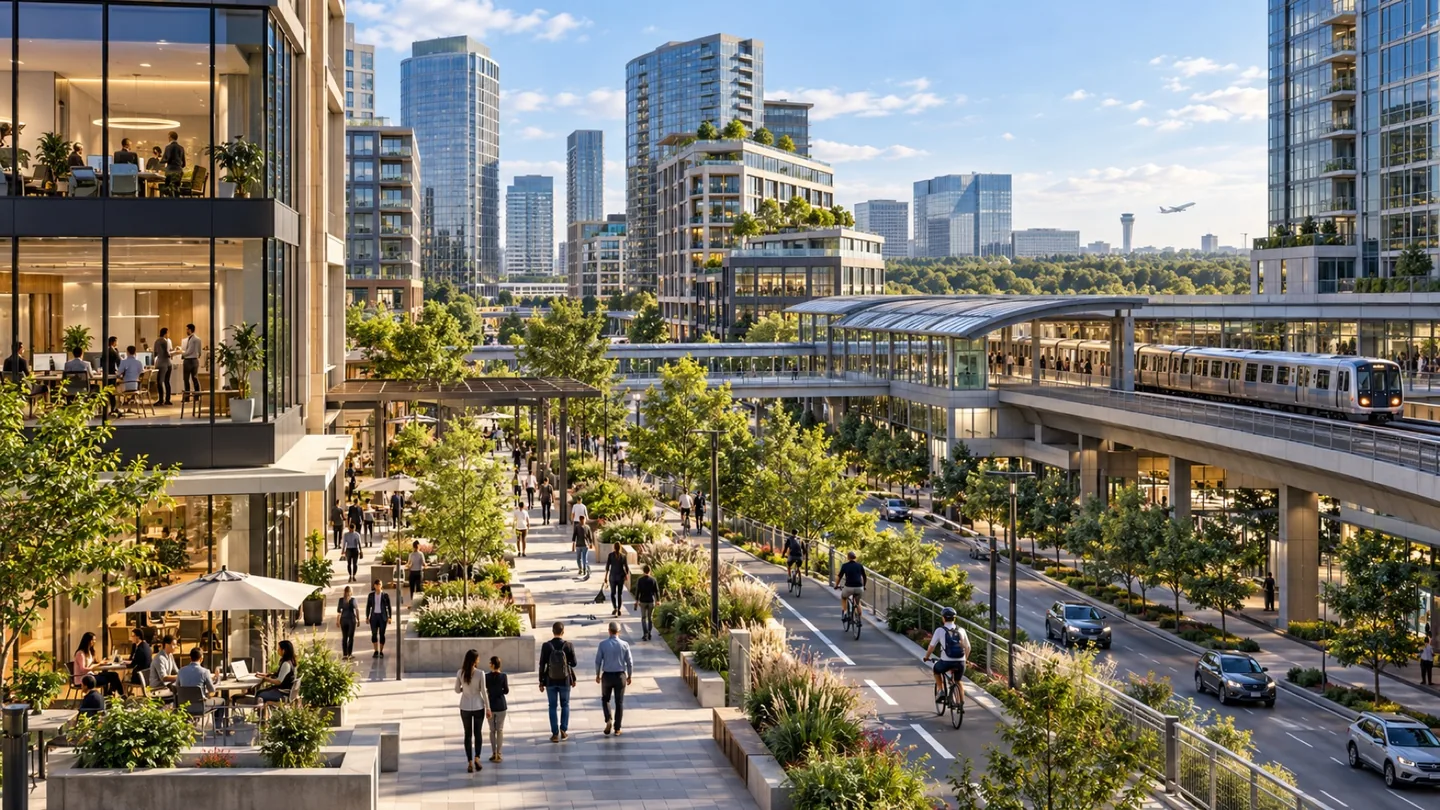
Clarendon brings together an Arlington Metro station, commercial streets and surrounding homes in a setting that changes from block to block. The county describes a mix of apartments, condominiums, single-family homes, offices, independent businesses and chains. Begin around Clarendon Metro, then include Market Common and the residential streets relevant to your visit. This gives a fuller picture than a single meal or apartment tour. Clarendon also has an important Vietnamese American history: its former Little Saigon was a center of commerce and community life.
Arlington's account of Little Saigon adds an essential chapter to Clarendon's story. Vietnamese refugees settled in the neighborhood following the fall of Saigon in 1975, and the commercial and social center they built flourished from the late 1970s into the mid-1980s. That history gives the area meaning beyond its present-day buildings and businesses. Read the county's historical material before a walk around the station, then look at how successive periods of development share the surrounding streets. The history is a reason to explore more carefully, rather than an assumption that the businesses or community gathering places of that period remain unchanged.
The station area, Clarendon Metro Park and the Olmstead Building provide useful orientation points in the county's planning description. Market Common adds another setting for comparing shops, homes and public-facing activity. Include the streets between those destinations rather than visiting only the interiors of individual businesses. For someone considering a home, the transition from a commercial frontage to a residential entrance can matter more than a broad neighborhood description. Visit the exact block during the hours you expect to use it, notice deliveries and gathering places, and test the route carrying what you normally bring home from an errand.
For a prospective home, evaluate the unit and building before assuming that the neighborhood name settles the decision. Check daylight, storage, delivery arrangements, bicycle access and any parking terms that matter to you. Visit from the direction you would usually arrive, and consider how the building relates to nearby activity. A commercial tenant should similarly review frontage, customer approach and building access. Official records and the property owner must resolve permitted uses and other requirements. Neither a generalized district description nor this guide establishes school eligibility, ownership costs or the condition of a particular property.
Clarendon station serves the Orange and Silver lines. Use WMATA's current trip information to choose the train and direction, then plan the part of the journey outside the station. A building advertised as near Metro still needs a useful route from its actual entrance. Compare crossings and the approach to the destination, particularly when carrying shopping or using a mobility aid. For an outing that includes Market Common and other stops, plot the sequence before deciding whether a car is useful. Guests and appointment clients should receive the correct building entrance and current parking instructions rather than only a neighborhood name.
Arlington’s official resources are the practical reference for property research, planning and service questions. Build a location checklist around an address rather than around a collection of neighborhood claims. Ask which responsibilities belong to the county and which belong to a building or association. For proposed changes nearby, identify the actual application and its stage. When accessibility is important, verify the route and facility directly rather than inferring it from a broad description such as walkable. A short visit with specific questions will often produce more useful information than a long list of generic amenities.
Clarendon's commercial mix includes both independent businesses and chains, according to Arlington's planning overview. That makes the individual offering and location more useful than a broad claim about the area's personality. For a first visit, distinguish a station-area destination from one farther along the surrounding commercial streets and check the entrance before setting a meeting point. For a prospective business location, observe the particular block during the intended operating hours, test customer and delivery access, and review the space's requirements with the owner and county. The area's Little Saigon history also shows why local commerce belongs within the community's wider cultural story.
SCHOOLS + STUDENT LIFE
A neighborhood name does not prove a school assignment, voting district, ward, precinct, tax parcel or service boundary. Use the exact address in the current official lookup and confirm unusual cases with the responsible agency.
The school system and enrolled school make individual assignment, enrollment, transfer and athletic-eligibility decisions.
CIVIC + EVERYDAY SERVICES
Planning-unit, school-boundary, transit-development and civic maps serve different purposes. Verify the exact address and the current APS school year.
Jurisdiction resources checked 2026-11-10. Recheck changing boundaries, officeholders, meeting dates and registration inventory at the official source.
USE THIS AREA WELL
Clarendon is a Metro-centered Arlington district where nightlife, retail, offices, apartments and older residential blocks meet. Its convenience depends on the exact block and time of day. A useful guide distinguishes the station core from neighboring Courthouse, Virginia Square and Lyon Village, then explains parking, late-night noise, bike and bus connections and the walk to everyday services.
The area's history includes Vietnamese businesses once identified with Little Saigon, and coverage should treat that history as part of the district rather than a footnote. Readers considering a move or business location should visit during both weekday commuting and a busy evening. Planning, preservation, street changes and business turnover all deserve continuing attention. Current information must be checked against Arlington sources and observed conditions.
BEFORE YOU CHOOSE
ONGOING COVERAGE
OFFICIAL STARTING POINTS
RELATED READING
guide
GUIDE
Five station areas offer a useful way into Arlington, but the best comparison happens on the blocks you would actually use.